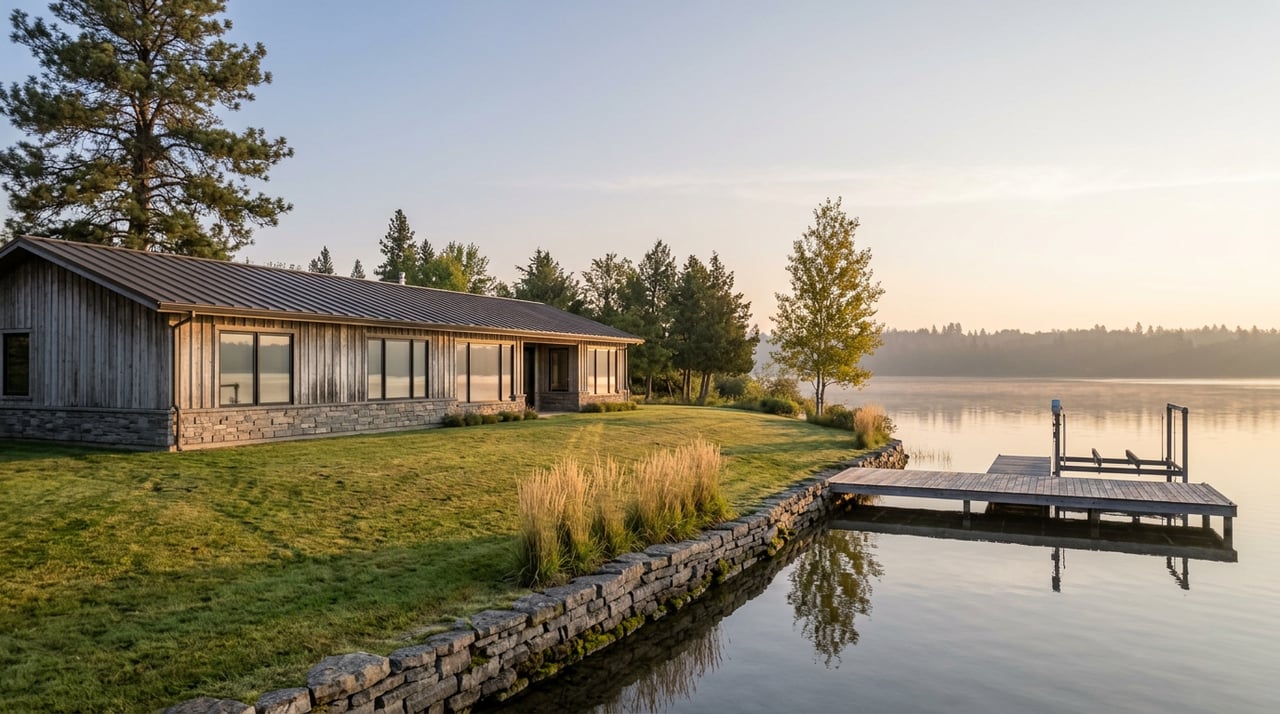
On the night of March 26, the Hayden City Council chambers filled past capacity for an item that had nothing to do with roads, schools, or taxes. It was about docks. Nancy Spencer, a Hayden Lake resident of 48 years, told the council that boats and their wakes have gotten larger while the lake has not. Tom Brown, who has owned lakefront property next to the marina for more than five decades, warned that added boat traffic would eventually chew into his shoreline and dock. By the end of the meeting, the council voted unanimously to withhold its support for a marina expansion that had been working its way through state permitting since the previous fall.
Two days later, the applicant withdrew the whole thing.
If you followed the headlines this spring, you already know that much. What's easy to miss, six months on, is what the fight actually revealed about how water access on this lake works, and why the pause that followed isn't the same thing as a resolution.
One marina, one gate
Hayden Lake has roughly 40 miles of shoreline and exactly one public marina. Hayden Lake Marina, at 3830 E Hayden Lake Rd, is the sole public moorage point on the entire lake. Everyone who doesn't own private waterfront with their own dock, and wants to keep a boat on Hayden Lake, goes through this one facility.
The marina wasn't always part of a larger portfolio. It was built up over roughly a decade by former owners Anders and Julie Hainer before Southern Marinas acquired it in 2021, one of four acquisitions the company closed that year as part of a push to build a geographically spread portfolio of marinas across the country. The current entity behind the property, Southern Marinas Hayden Lake LLC, operates as a partnership between Southern Marinas and a Denver-based private investment firm. That structure matters here because it means the decision-making body for the only public gate onto a 40-mile lake sits several states away from the water it manages.
The marina currently offers 216 wet slips. That's the number every current slip-holder, every person on the waitlist, and every boater without private frontage is competing for.
What the application actually asked for
In October 2025, Southern Marinas Hayden Lake LLC filed an application with the Idaho Department of Lands to reconfigure the marina's docks, add 32 new slips for a total of 247, relocate the fuel dispensers and gas lines, and install a new publicly accessible pump-out facility. The applicant's stated reasoning, reported first by the Coeur d'Alene Press in February, was straightforward: boats have gotten bigger, industry-standard vessels now run 24 to 26 feet, and the existing configuration was built for a smaller fleet. The company also pointed to a "substantial" waitlist as evidence of unmet demand for slips of that size.
That framing, more capacity to meet demand, sounds simple enough until you look at what a pump-out station actually changes. The Hayden Lake Watershed Association, in its review of the application, flagged a consequence that had nothing to do with slip count.
The pump-out station may enable houseboats to anchor in Hayden Lake Bays.
A pump-out facility isn't just a convenience upgrade. It's the piece of infrastructure that makes overnight anchoring by larger vessels, including houseboats, practical in bays where it currently isn't. The watershed association's other objections were more familiar: inadequate parking, added traffic on Hayden Lake Road, and safety concerns about moving fuel pumps farther from the shoreline. But the houseboat detail was the one that reframed the debate from "how many slips" to "what kinds of use this lake will support going forward."
Not a clean two-sided story
It would be tidy to describe this as residents against a marina company, but the record from this spring doesn't support that. Andrea Zinnecker, who described herself as having been on the marina's waitlist for several years, called the project a clear benefit to the lake and the local community. Steve Petroni, a nearby resident, took a more measured view, telling the Press that while the dock extension would reduce his view of part of the lake, the traffic reduction from the new configuration outweighed that loss for him personally.
Set against that were the residents who spoke at the March 26 council meeting and the ones who wrote in through the formal comment period that closed February 24. Brookes Spencer, reached after the withdrawal, was careful to note that the objection was never to the marina's existence. His issue, and the one echoed by others, was the scale of the proposal and what he called the complete absence of community consultation during what he said had been two and a half years of planning on the applicant's side.
That distinction, supporting the marina but objecting to this particular version of it, is worth sitting with if you live near the water. The fight wasn't about whether Hayden Lake should have a marina. It was about who gets a say in how that single point of public access changes.
Here's how the sequence actually ran, start to withdrawal:
- October 2025 — Southern Marinas Hayden Lake LLC files its application with the Idaho Department of Lands.
- January 23 and 30, 2026 — Public notice of the application runs, opening a formal 30-day objection window.
- February 12, 2026 — The Coeur d'Alene Press first reports the proposal's details publicly.
- February 24, 2026 — Deadline for written objections to the Idaho Department of Lands.
- March 26, 2026 — Hayden City Council votes unanimously to withhold its letter of support.
- March 27, 2026 — Southern Marinas withdraws the application.
- April 15, 2026 — The public hearing that had been scheduled with the state is canceled as a direct result of the withdrawal.
A pause, not an ending
Marina general manager Lindsey Olmstead framed the withdrawal in a written notice as a decision to pause so the company could better understand the needs and priorities of the Hayden Lake community before revisiting the design. Jan Wilkins, president of the Hayden Lake Watershed Association, welcomed the outcome but was equally careful about the tense she used. She said the association hoped that if the applicant returns with a revised proposal, it would be developed in genuine partnership with the community from the outset, calling that "a conversation we would welcome."
That word, if, is doing real work. A follow-up report on April 1 quoted a project representative, speaking anonymously, who said the organizers had paused their efforts and were reassessing next steps while shifting focus to other projects. At the time, there was no timeline for whether the current application, a revised version, or nothing at all would come next. The advocacy group that formed around the fight, Citizens Against Hayden Lake Marina Expansion, still lists the application's status on its own site as withdrawn, with no new filing tracked since, nearly six months later.
What actually didn't change
The council vote and the withdrawal resolved the immediate conflict. They didn't resolve the arithmetic that produced it. The marina still has 216 slips built for a smaller average boat than what shows up on the lake today. The waitlist the applicant described as substantial hasn't shrunk because the application went away. And the lake still has exactly one public gate through which all of that pressure has to pass, owned by an out-of-state investment partnership whose only formal accountability to the community runs through a state land-use permit process that can be restarted at any time.
None of that means another proposal is coming, or when. It does mean that anyone who lives on or near Hayden Lake, or who keeps a boat here, is watching a story that paused mid-sentence rather than one that ended. The comment period is closed for now. The next one, whenever it opens, will move fast, the way this one did between its February press coverage and its March 26 vote. Knowing the shape of what already happened is the only way to be ready for what happens if it starts again.
For residents who want to understand what this kind of shift, in permitting, in ownership, or in shoreline use, actually means for property near the water, Gunther & Co. has spent years tracking how North Idaho's lakes are governed and how that governance shows up in real decisions about docks, access, and value. If you have questions about how a specific stretch of Hayden Lake shoreline is affected by any of this, schedule a free consultation and we'll walk through it with you directly.