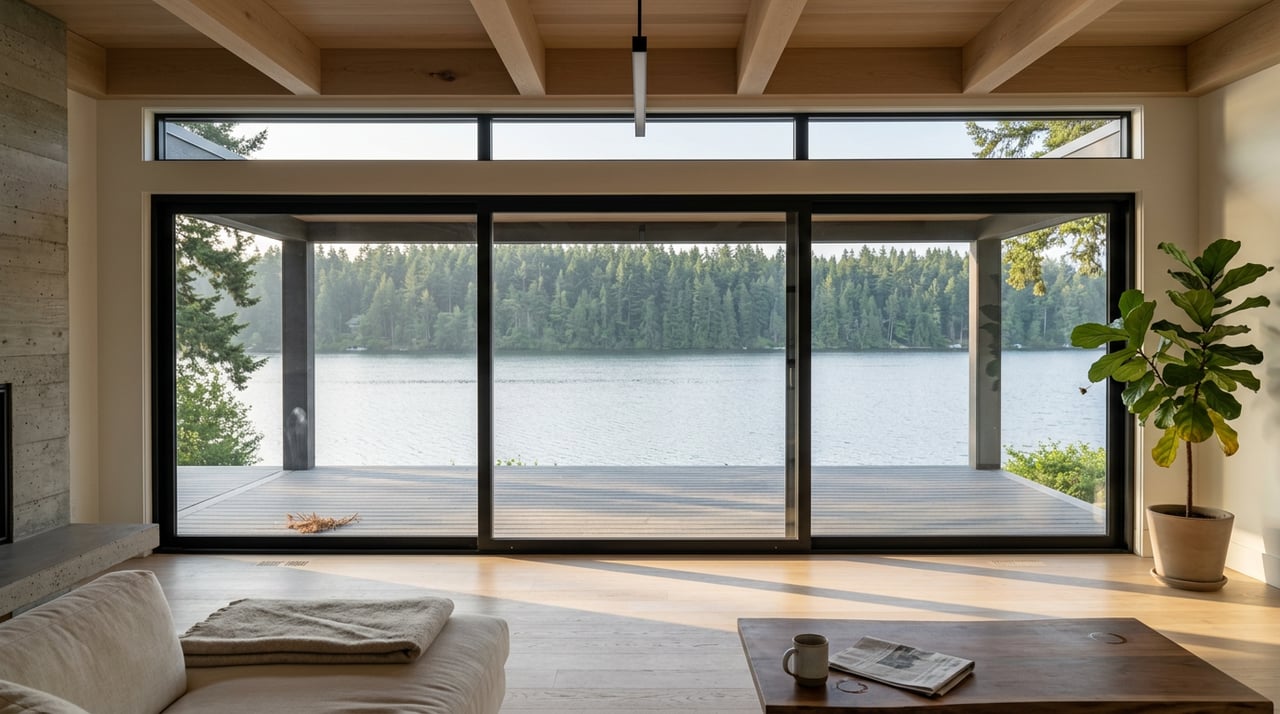
A buyer relocating from the Bay Area asked us last month why a 3,700-square-foot home on Atlas Waterfront was listed at $1,875,000 when every portal she opened showed Coeur d'Alene's median hovering around $601,000. She had done the math the way portals train buyers to do it. Price per square foot, comps within a mile, days on market. None of it explained the gap.
The gap is not a mystery. It is a jurisdictional artifact. Coeur d'Alene has two housing markets stacked on top of each other, and which one an address belongs to is decided by who regulates the water in front of the seawall, not by the square footage of the house behind it. If you are shopping the shoreline and using the citywide median as a reference point, you are pricing a boat by looking at the trailer.
The number that gets quoted, and the number that actually matters
As of March 2026, the citywide median sold price sat near $601,000, up roughly 4.6% year over year, with about 521 active listings and 45 average days on market. Redfin's three-month window ending April 2026 landed at $596,000 across 229 April sales. The Coeur d'Alene Regional Realtors closed 2025 at a county median of $549,000 on 2,484 transactions, and their president Jennifer Smock characterized 2026 as steady, with a slight tilt toward more inventory. Those are the numbers portals surface.
Now filter for waterfront. As of March 1, 2026, only 27 active waterfront listings existed in Coeur d'Alene. Average days on market ran 73, average price per square foot was $599, and the median list price was $1,875,000. That is roughly three times the citywide median, on a submarket that turns over about five percent as often. When people talk about "the Coeur d'Alene market," they are almost always describing 475 non-waterfront listings and quietly excluding the 27 that most out-of-state buyers actually flew in to see.
This matters because the two markets do not move together. Citywide inventory is loosening. Waterfront inventory is not. A buyer who waits six months for "the market to soften" may find the citywide median flat and the shoreline median unchanged, because the shoreline is not really priced against local demand. It is priced against a national pool of second-home buyers weighing Lake Coeur d'Alene against Flathead, Tahoe, and Lake Chelan.
The dock is doing the pricing
Here is the part portals cannot show you. A waterfront home in Coeur d'Alene is really two assets sold together: the upland house, which is priced like any other high-end residence, and the encroachment permit for the dock, which is priced like a scarce license. The house depreciates. The permit does not.
Every dock, marina, breakwater, and shoreline stabilization structure on a navigable Idaho lake requires an encroachment permit from the Idaho Department of Lands under the Lake Protection Act, Idaho Code Title 58, Chapter 13. When waterfront property changes hands, the existing permit does not automatically follow. The buyer and seller must submit a Request for Assignment form with a $300 fee to the appropriate Supervisory Area Office. For Lake Coeur d'Alene, that office sits at 3706 Industrial Avenue South in Coeur d'Alene.
The permit itself carries physical limits worth memorizing before you tour a property:
Single-family dock encroachments cannot exceed 700 square feet in area or 10 feet in width, with an approach ramp no wider than 6 feet and no more than four pilings. The structure must sit at least 10 feet from adjacent property or riparian boundary lines without written consent from the neighbor. Commercial encroachments require a 25-foot setback.
If the dock a buyer walks out onto during a showing exceeds those dimensions, one of two things is true. Either the encroachment predates 1975 and has not been modified since, in which case IDL can permit it without a fee if age can be documented through dated aerial photography or tax records, or the permit is generous because it was issued under prior standards. Both scenarios are transferable, but the first is fragile. Any modification triggers a re-review at current standards, which means an oversized legacy dock can shrink the day a new owner decides to replace the decking.
That is the mechanism sellers rarely explain and buyers almost never ask about. Two identical-looking homes on adjacent lots can carry different long-term values because one dock is grandfathered at 900 square feet and the other is capped at 700. On a resale in five years, the difference could show up as six figures.
Two regulators, one lake
Here is where relocation buyers get caught. Lake Coeur d'Alene is not a single regulatory environment. The southern portion sits within the Coeur d'Alene Reservation, and docks there fall under the Coeur d'Alene Tribe Recreation Management Program, not IDL. Tribal Law and Order Code Chapter 44-8.01(D) treats any encroachment on tribal submerged lands without a current permit and lease as an unlawful trespass.
| Item | IDL waters (north lake) | Tribal waters (south lake) |
|---|---|---|
| Regulator | Idaho Department of Lands | Coeur d'Alene Tribe Recreation Management Program |
| Transfer document | Request for Assignment, $300 fee | Encroachment Dock Lease Transfer Application |
| Transfer deadline | Submit to Supervisory Area Office | Within 30 days of ownership change |
| New permit lead time | Varies by hearing schedule | 90 days recommended before construction |
| Governing authority | Lake Protection Act, IDAPA 20.03.04 | Tribal Encroachment Standards, adopted June 2005 |
A buyer coming from California may assume "state permit" applies uniformly across the shoreline. It does not. Escrow can close on a southern-lake property with a dock that requires a tribal lease transfer the new owner did not know existed, and 30 days later the encroachment number attached to the property is out of compliance. That is not a hypothetical failure mode. It is a documented one.
Kootenai County reinforces the split in its public FAQ. The county's Parks and Waterways division maintains public launches and marks navigational hazards but has no jurisdiction over private dock permits. That authority sits with IDL or the Tribe, depending on the parcel.
What changes July 1, 2026
For anyone closing this summer, the timing matters. The 2026 Idaho Legislature approved updated IDAPA 20.03.04 rules governing beds, waters, and airspace over navigable lakes, and the revised rules take effect July 1, 2026. If a permit assignment is filed before that date, it is processed under the outgoing standards. Filed after, the new rules govern. Sellers with permits in flight and buyers negotiating dock modifications as a closing condition should confirm with the Coeur d'Alene office which framework will apply.
The rule change is not a footnote. Encroachment applications are decided case by case, and objections from adjacent owners can force a formal administrative hearing. In 2022, IDL Director Dustin Miller denied a dock application near City Beach after Coeur d'Alene City Attorney Randy Adams objected, citing the 2000 Idaho Supreme Court decision in Dupont v. Idaho State Board of Land Commissioners. Thirteen waterfront properties sit between North Idaho College and Fort Sherman Park with no private docks. Buyers occasionally assume they can be the first. The record suggests otherwise.
Frequently asked
If a listing says "dock included," does that mean the permit transfers automatically? No. The physical structure conveys with the sale, but the encroachment permit requires a separate assignment filing with IDL or a lease transfer with the Coeur d'Alene Tribe. A closing can technically fund without that paperwork completed, which is a risk buyers should surface during due diligence, not after.
Why is the waterfront median list price so much higher than actual sold prices citywide? Two reasons. First, waterfront inventory is thin, with 27 active listings versus 475 citywide as of spring 2026, so the median is drawn from a small, high-end pool. Second, waterfront is priced against out-of-state second-home demand from markets including Los Angeles, Seattle, and Portland, according to migration data, rather than against local wage growth.
Can a buyer add a new dock to a waterfront home that does not have one? Sometimes. New encroachment permits require an application, notice to adjacent riparian owners, and, if objections cannot be resolved, a formal IDL hearing. Approval is not guaranteed, and denials happen, particularly where designated swimming areas, tribal waters, or established public uses are involved. Anyone treating a new-dock permit as a certainty is underwriting a risk they have not measured.
The buyer from the Bay Area eventually wrote an offer on a low-bluff property in Bennett Bay. She did it after we spent two hours reading the encroachment number on the existing dock against the current permit, confirming setbacks against the adjacent parcel, and building the assignment fee and lease review into her closing checklist. That is the work the median cannot do for you.
If you are weighing a waterfront purchase on Lake Coeur d'Alene this season, or preparing to list one, the dock is not a detail. It is the deal. Gunther & Co. works through the encroachment record, the jurisdictional map, and the permit timeline alongside the offer itself, so the price you agree to matches the asset you actually receive. Schedule a free consultation when you are ready to look past the median.